Copper Press Reducing Coupling – For Press-Connect Transitions in Potable Water and Hydronic Systems
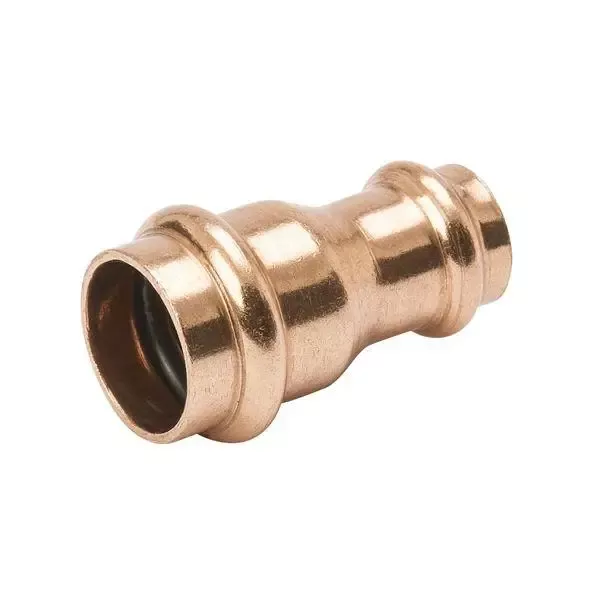
The Copper Press Reducing Coupling is a press-fit fitting designed for joining copper tubing of two different diameters in pressure and non-pressure piping systems. Manufactured from lead-free wrought copper or copper alloy, this fitting provides a mechanical, flame-free connection method suitable for potable water, heating, chilled water, and low-pressure steam applications.
Equipped with integrated press ends and EPDM sealing elements, the coupling allows for fast installation without soldering, threading, or welding. The press-connect system provides uniform compression around the pipe circumference when crimped using an approved pressing tool, ensuring a permanent, leak-resistant joint.
Key Features
- Press End Configuration – Designed for use with ASTM B88 Type K, L, or M copper tubing
- Reducing Design – Connects copper pipes of differing nominal sizes for branch or line transitions
- Sealing Element: EPDM O-rings pre-installed, suitable for potable water and hydronic applications
- Lead-Free Alloy – Complies with NSF/ANSI 61 and 372 standards for drinking water systems
- Flame-Free Installation – Eliminates open-flame work, reducing jobsite hazards and enabling faster work in occupied buildings
Technical Specifications
- Material: Wrought copper or DZR brass (depending on manufacturer)
- Sizes: Available in a range of reducing configurations (e.g., 1″ x 3/4″, 2″ x 1-1/2″)
- Connection: Press x Press
- Operating Pressure: Typically rated up to 200–250 PSI depending on system type and pipe size
- Temperature Range: 0°F to 250°F (varies by sealing element material)
- Standards: ASME B16.51, NSF/ANSI 61 & 372, IAPMO/UPC Listed
Applications
Used in domestic water systems, radiant heating loops, chilled water circuits, and other closed-loop mechanical piping networks. Common in both new construction and retrofit scenarios where joint access or flame restrictions make press technology preferable.
Installation Note
Use manufacturer-specified pressing tools and jaw profiles to ensure a code-compliant installation. Verify sealing element compatibility when used in chemical or high-temperature systems. Proper pipe preparation—cutting, deburring, and cleaning—is critical to system integrity.